
THE PRAGMATIC IMPERATIVE
For business owners and top-level managers operating in Vietnam, the final stage of delivery is not merely a logistical function. It represents a critical barrier between potential revenue and actual cash flow. Successful "last-mile" delivery not only determines end-customer satisfaction but also directly impacts operational profitability and capital turnover speed. Ignoring the specifics of this phase leads to uncontrolled costs, delays in payment collection, and consequently, margin erosion. The business objective is to create a predictable, controllable, and economically efficient mechanism for delivering goods to the consumer, taking into account the unique characteristics of the local market. This is a strategic task demanding a systematic approach, not situational fixes.
Last-mile efficiency in Vietnam is not a matter of service quality; it's a matter of survival. Every delay or error in delivery translates directly into lost potential profit and increased operational risks. The focus must be on minimizing variables, rather than pursuing an ideal.
OPERATIONAL FILTERS
Vietnam's operational environment introduces significant adjustments to standard logistics models. Understanding these factors is critically important for building a sustainable delivery system.
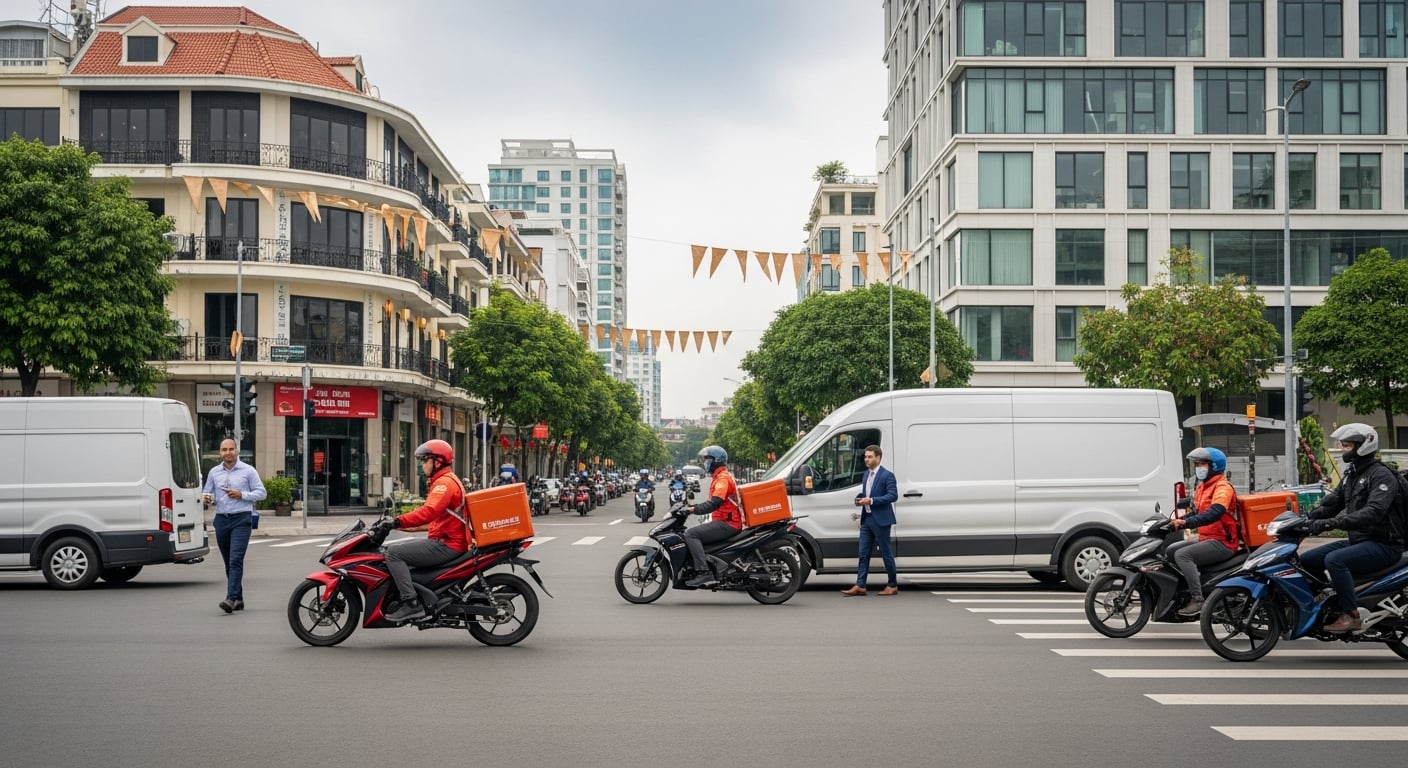
- Urban Congestion and Infrastructure: Major urban agglomerations like Ho Chi Minh City and Hanoi are characterized by high traffic density and limited road capacity. This not only slows down deliveries but also makes delivery times highly unpredictable, directly impacting planning and customer satisfaction. The road network can be fragmented, especially in residential areas and suburbs.
- Addressing Specifics: The address system in Vietnam has its own peculiarities, which can differ from familiar Western standards. The absence of clear building numbers, the presence of many identical or similar street names, and the use of informal landmarks can lead to difficulties in identifying the exact delivery location. This demands additional effort and local knowledge from courier services.
- Cash-on-Delivery (COD) Methods: Cash-on-delivery (COD) remains a dominant payment method, especially for online purchases. This factor creates a complex operational area with a high cost of error. Courier services assume cash collection functions, which increases delivery time, adds security risks, and complicates the financial reconciliation and collection process. The problem here is often not in sales, but in efficient fund collection.
- Choosing Courier Services: Vietnam's courier service market is highly competitive, featuring both large national players and numerous smaller regional providers. Each has its strengths, geographical coverage, and pricing policies. The lack of uniform quality standards and technological integration among all market participants requires careful auditing and partner selection to match specific business needs. Otherwise, there is a risk of losing operational control and eroding margins.
THE ECONOMICS OF THE PROCESS
Profitability in last-mile delivery in Vietnam can easily vanish due to factors that are not immediately obvious. The economics of the process are highly sensitive to operational disruptions.
- Unit Economics: Each order has its own delivery cost. If the percentage of successful deliveries decreases, or if the number of re-delivery attempts increases due to addressing or payment difficulties, the cost per unit of goods rises, reducing gross profit. Additional costs for processing returns or storing undelivered items also burden unit economics.
- Returns and Cancellations: A high percentage of COD orders entails an increased risk of purchase refusal upon delivery. Unexpected returns generate additional logistical costs for reverse transportation, storage, and repackaging. This doesn't even account for lost sales opportunities and the need to find a buyer again. This represents a direct financial loss, increasing the cost of customer acquisition.
- Cash Flow Gaps due to COD: Delays in collecting funds from courier services can lead to significant cash flow gaps, especially for companies with a large volume of orders and a high proportion of COD. Courier services typically remit collected funds at set intervals, which requires businesses to have additional working capital to sustain operations. This directly impacts the company's cash flow and liquidity.
- Regulatory and Tax Obligations: Delivery and cash-on-delivery payment processing activities are subject to local regulatory requirements and tax norms. Non-compliance or incorrect understanding of these rules can lead to fines and additional expenses, increasing overall operational costs.
DELIVERY MODEL AUDIT
The selection of a last-mile organization model must be based on a sober assessment of capabilities, risks, and the desired level of control.
Model 1: Delivery via Marketplace.
- Control: Low. The marketplace dictates terms, selects the courier, and sets standards. The business has minimal influence over the delivery process once the goods are handed over.
- Risks: Dependence on marketplace standards and performance. Loss of direct customer contact. Potential increase in delivery commissions. Reputational threat in case of marketplace failures.
- Advantages: Ease of launch, no proprietary infrastructure required, scalability.
Model 2: Proprietary Courier Service.
- Control: High. Full control over every stage of delivery, staff training, service standards, and payment collection.
- Risks: Significant capital expenditure for fleet creation and maintenance, staff hiring and training, software development or acquisition. High operational costs. Necessity of managing a complex operational area with a high cost of error, including personnel management, routing, and maintenance. Scaling factor: effective for large, concentrated volumes.
- Advantages: Full brand experience, service flexibility, direct collection of delivery data, potentially higher speed and quality in specific zones.
Model 3: Partnership with Local Courier Services (3PL).
- Control: Medium. The business selects partners, but control over each specific courier is limited. SLA monitoring and regular performance audits are necessary.
- Risks: Dependence on partner service quality, potential encounter with fragmented courier infrastructure, challenges in IT system integration, variability in service quality. Risk of losing operational control and margin erosion due to partner failures.
- Advantages: Reduced capital expenditure, access to existing infrastructure and expertise, scalability, ability to choose the best providers for different regions.
Choosing a delivery strategy is a management decision based on balancing control, cost, and scalability. There is no one-size-fits-all solution. It's crucial to assess your own operational capacity and willingness to accept associated risks.
SOLUTION ALGORITHM
Optimizing the last mile in Vietnam requires a systematic approach. Avoid starting with inflated expectations.
-
Pilot Phase and Data Collection:
- Begin with a limited geographical area or product segment.
- Test 2-3 potential courier partners.
- Record key metrics: average delivery time, successful delivery rate, return rate, COD collection time, number of customer inquiries regarding delivery.
-
Analysis and Provider Selection:
- Based on pilot data, objectively evaluate each partner's performance.
- Prioritize those who demonstrate predictability, reliability, and transparency in COD processing.
- Do not limit yourself to a single provider; consider a multi-partner strategy for different regions or product types.
-
Process Standardization and Optimization:
- Develop clear internal protocols for preparing orders for shipment (packaging, labeling, documentation).
- Implement standards for collecting and verifying customer addresses during order placement.
- Optimize the order handover process to couriers to minimize idle time.
- Regularly reconcile collected COD funds to prevent discrepancies, remembering that the problem is not in sales, but in collecting the money.
-
Technological Integration:
- Utilize APIs to automate data exchange with selected courier services. This includes order transmission, delivery status tracking, and automatic payment data updates.
- Implement a delivery performance monitoring system that allows for real-time tracking of key metrics.
- Integrate CRM or ERP systems with delivery data for a complete customer and order management cycle.
-
Scaling and Continuous Improvement:
- Gradually expand geographical coverage, applying processes refined during the pilot.
- Regularly review partnership agreements and terms based on changing market needs and partner performance.
- Maintain open dialogue with partners for joint process optimization and problem-solving to minimize the risk of losing operational control.