
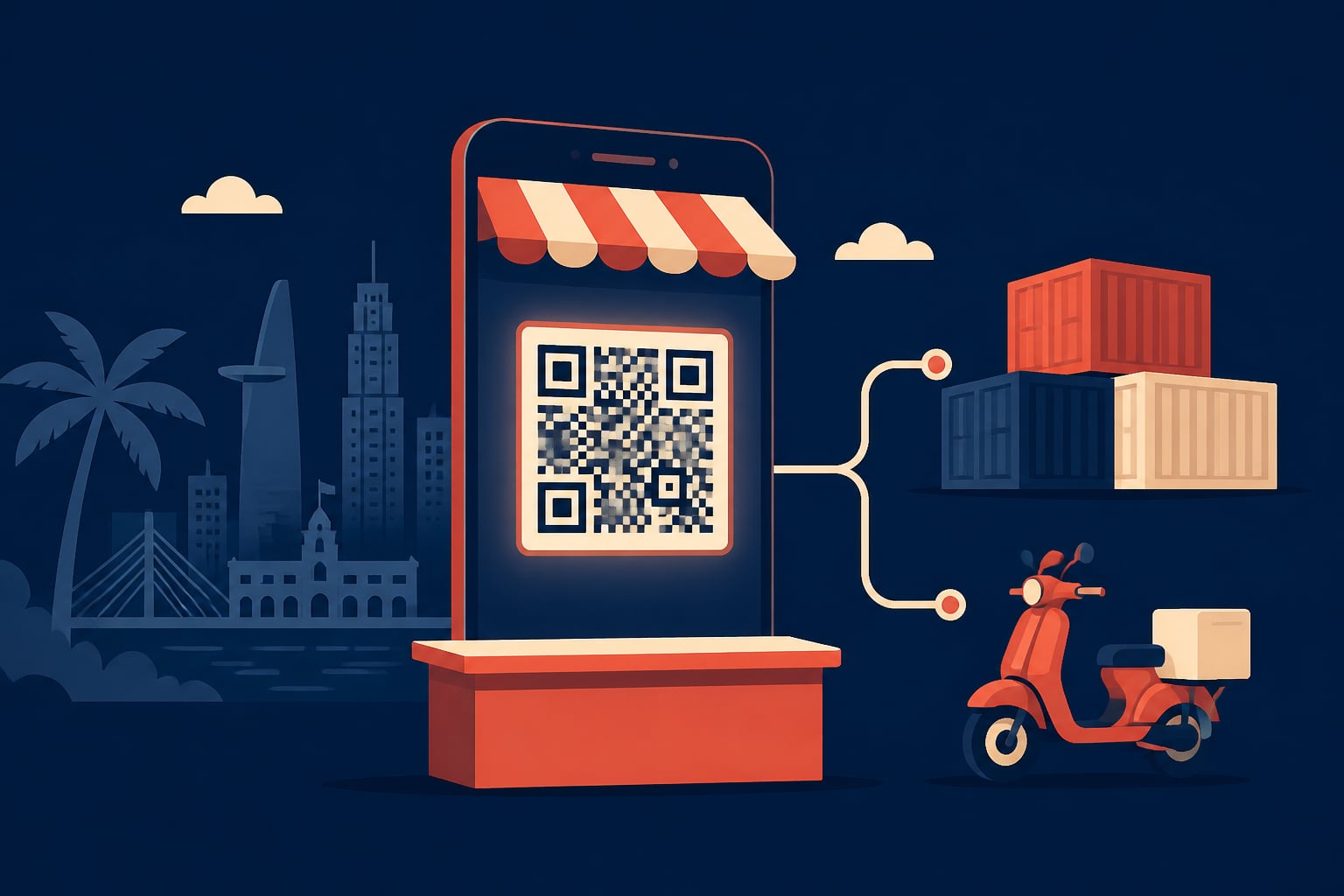
I hear it at every other meeting with a brand eyeing Southeast Asia: "Vietnam is interesting, but nobody buys anything without a card, and building payment infrastructure is a separate six-month project." The logic is understandable. And it's as outdated as the very notion of a "country without cards."
Over the past year and a half, Vietnam has done what markets several times larger usually do: it consolidated cross-border QR infrastructure into a national standard and began connecting its neighbors to it. For a Russian seller, this isn't an abstract fintech news item. It's a direct change in how much the first payment from a Vietnamese buyer costs.
What Happened
First, the basics. Back in November 2024, the State Bank of Vietnam (SBV) signed Decision No.2525/QD-NHNN — a national technical standard for the QR code displayed on the buyer's side. Simply put: a single format that any Vietnamese wallet and any bank can read from the same code. Without this, cross-border doesn't come together.
Then things moved faster. In July 2025, the Vietnam Banks Association (VNBA) finalized the Handbook on Cross-Border QR Payments — a document regulating scope, fee principles, logos, and anti-fraud and anti-money laundering measures. In December 2025, a link with China via UnionPay International and VietQRGlobal was officially launched — according to State Council / Xinhua, initially one-way, with the reverse direction planned for 2026.
And on July 2, 2026, NAPAS, together with Singapore's Liquid Group and VietinBank, launched a Vietnam–Singapore service via VietQRGlobal acceptance points. This is reported by VNBA. This is no longer a paper pilot. It's a working corridor.
What the Data Shows
The volumes explain why banks are in such a hurry. According to Báo Chính phủ (October 2026), during the reporting period there were 311 million QR transactions worth VND 274.2 trillion — up 6.66% in volume and 25.85% in value year-on-year. Note the gap: volume is growing slower than value. This means the average QR ticket is increasing — people aren't just paying for coffee with a code.
A separate figure from the SBV report for the 11 months of 2025: QR payments grew by 54.45% in transaction count and 141.02% in value compared to the same period in 2024. The methodologies of these two snapshots differ — SBV counts by 11 months, the government channel by its own period. They can't be compared directly, and I emphasize this deliberately: when someone shows you "2.4x growth" in a presentation, ask what exactly and for what period.
And most importantly for our topic. At Vietnam Digital Payment Day 2026, SBV representatives stated that in tourism and cross-border scenarios, QR is already linked with more than 60 countries and territories — as reported by Tuổi Trẻ. Plus, in May 2026, RBI and SBV signed a memorandum on payment system compatibility, including cross-border QR.
Where the Shift Lies
It seems like a story about tourists. A Chinese tourist arrives in Da Nang, pays for a souvenir with a code. Nice, but irrelevant to Russian e-commerce.
In fact, it is relevant, and here's why. Previously, the barrier to entry into the Vietnamese market for an external seller looked like this: local acquiring, a contract with a bank, integration, deposits, currency control on each side. Each item meant money and time. Cross-border QR removes the first layer: the buyer pays from their usual app, the seller accepts through partner infrastructure instead of building their own.
It's not the fee amount that changes. It's the type of decision. Previously the question was "can we handle a payment project in Vietnam." Now it's "do we connect to a ready-made corridor." These are different budgets and different timelines.

And another layer that's often missed. QR is not just payment. It's a buyer identifier at the moment of purchase. When a payment goes through a linked system, you get order attribution to the channel and geography. For a marketplace, this means you can calculate where the paying customer actually came from, rather than guessing from targeting settings.
Where the Risks Are Hidden
I'm not arguing that infrastructure has become simpler. But there are three places where Russian sellers most often stumble, and they're not about technology.
- Currency control. Cross-border QR solves acceptance, but it doesn't solve how money legally reaches a Russian company and on what basis.
- Compliance. The VNBA Handbook explicitly describes AML and anti-fraud measures. Your payment partner will request documents on the goods and the company.
- Partner dependency. The corridor works as long as both sides work. Changing partners means rebuilding the integration.
That's why I always tell brands: QR lowers the cost of entry, but it doesn't eliminate the legal structure. It's not about "how to accept money." It's about "how to explain where it came from."
What I See from Operations
At VietSmart, we onboard partners to Shopee Mall and run local channels in Ho Chi Minh City. And here's what's noticeable in practice: the Vietnamese buyer almost never asks "can I pay by card?" They ask "do you accept QR?" The habit of paying by code here is already everyday, not touristy.
Second observation. When a brand gets local payment acceptance, cart-to-order conversion behaves more steadily — especially in categories where the average ticket is above average. I won't give an exact percentage: it heavily depends on the category and on which marketplace the traffic comes through. But the direction has been stable for the second year in a row.
Third. Brands that enter through a marketplace rather than their own website get payment infrastructure "included" with the listing. That's the new cost of entry: you don't build acquiring, you use what the platform has already connected.
What a Brand Should Do
If Vietnam is in your plans for 2026–2027, here's a verifiable sequence of actions.
- Ask your potential payment partner for written confirmation of which cross-border corridors are live and which are still in project. The difference is critical.
- Check whether the partner supports acceptance via VietQRGlobal, and clarify which Vietnamese issuing banks are in the scheme.
- Prepare the document package for the goods and company in advance — according to the AML requirements from the VNBA Handbook. This speeds up onboarding by weeks.
- Run the unit economics with the partner's actual fee, not the one quoted at the first meeting. Cross-border fees and local acquiring fees are different numbers.
- Launch a pilot in one category through a marketplace before building your own channel. This way you test demand before investing in infrastructure.
Realistic timelines: marketplace listing — 3–4 weeks, connecting cross-border acceptance through a partner — 4–8 weeks depending on document readiness. Not "tomorrow," but not six months either.
Vietnam has stopped being a market where payment is a separate project. It has become a market where payment is a connection. If QR infrastructure has already linked 60 countries, what happens when your category is added to it?
At VietSmart, we handle the operational part: we select a payment partner for your model, assemble the AML-required package, and launch first sales through a marketplace in 60–90 days. After that, you calculate unit economics on live data, not on a presentation.