THE PRAGMATICS OF INTENT. What Real Business Challenge Do Owners Face in This Sector?
Organizing the logistics of oversized goods in Vietnam is not a trivial task; it's a strategic challenge that directly impacts operational efficiency and business margins. For business owners or top managers, the key objective extends beyond simply moving cargo to preserving its value and minimizing risks within a complex operational environment.
Standard logistics solutions, effective for bulk small shipments, prove inadequate when dealing with furniture, building materials, or industrial equipment. This leads to hidden costs, delays, damages, and a loss of operational control. Businesses not only need to deliver goods but also to guarantee their integrity, timeliness, and the economic viability of the process, while avoiding common problems.
OPERATIONAL FILTER. How the Process Works 'On the Ground'. Describing Mechanisms (Logistics, Taxes, Risks) Without Panic.
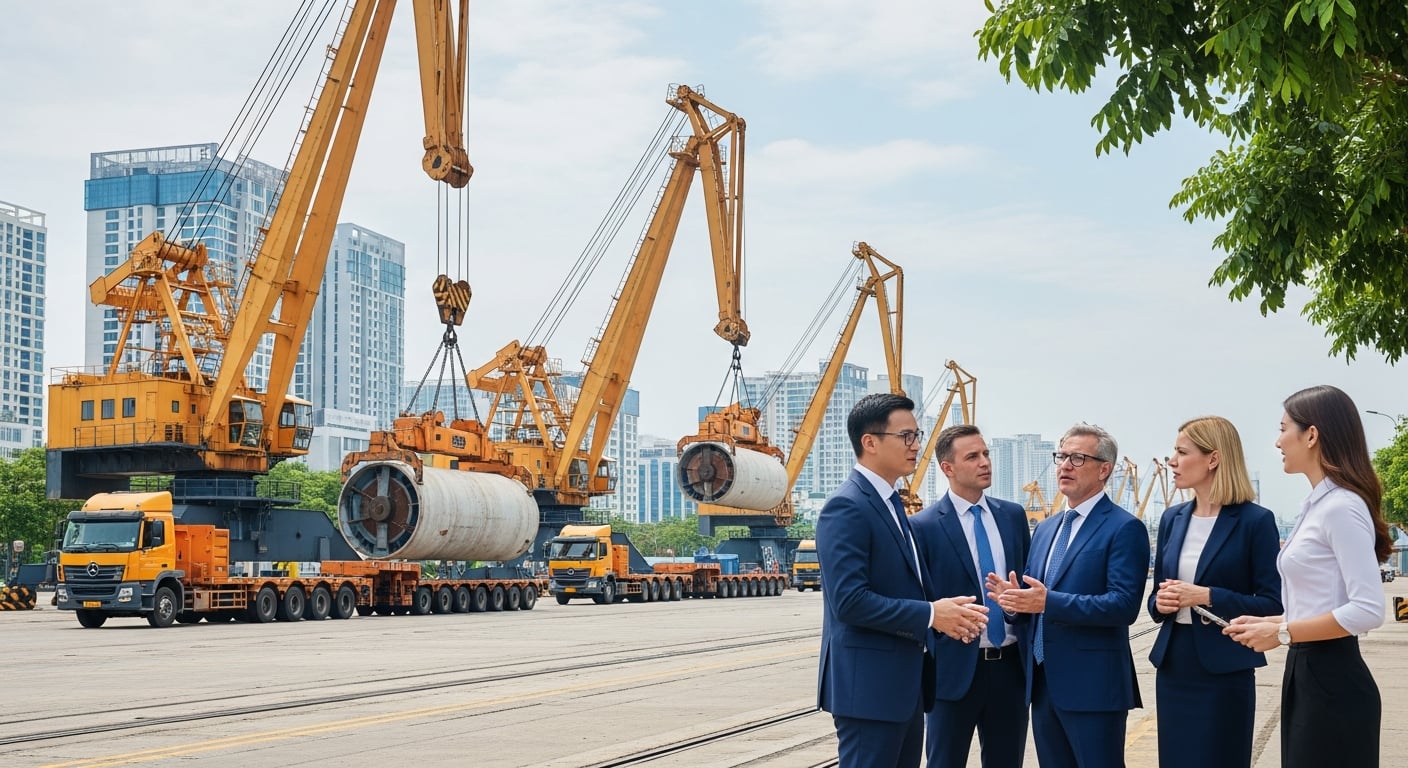
Transporting oversized goods in Vietnam faces objective infrastructural limitations. The road network, especially outside major economic centers, may be unsuitable for heavy-duty transport, necessitating complex and lengthy routes. Specialized vehicles (flatbeds, low-loader platforms) are limited, demanding meticulous planning and coordination.
The regulatory environment requires special permits for oversized cargo, route approval, and adherence to time restrictions, particularly within urban areas. Customs clearance for industrial equipment demands precise classification and may involve additional inspections, increasing administrative and time costs. Seasonal factors also impact road accessibility and safety.

Storing such goods requires specialized warehouses with appropriate infrastructure: sufficient clear spans, reinforced floors, and heavy-lifting equipment. A lack thereof necessitates temporary solutions, increasing the risks of damage and costs. The fragmented courier infrastructure exacerbates the situation, requiring engagement with multiple contractors and elevating the risk of losing operational control.
THE ECONOMICS OF THE PROCESS. Where and Why Profit Disappears (Unit Economics, Returns, Taxes).
Profitability in oversized goods logistics directly correlates with unit costs. Rates for specialized transport and storage are significantly higher, increasing the cost of goods sold per unit. Underestimating insurance costs and potential damages is a common mistake. Returns or replacement of damaged oversized goods incur substantial operational expenses, including reverse logistics and disposal, which sharply reduces shipment margins.
Customs duties and taxes, along with potential penalties for incorrect classification or missing documentation, tie up working capital and degrade unit economics. Hidden operational costs, such as overtime pay, temporary storage due to delays, or additional fuel expenses, can accumulate to nullify projected profits. In essence, the challenge is not just in cost formation but in preserving value throughout the payment collection process for services rendered or goods sold.
A lack of transparency in logistics operators' pricing often leads to overpayments for inefficient services. This creates a risk of losing operational control and eroding margins, especially in the long run.
MODEL AUDIT. Comparing Solutions (Marketplace vs. In-House vs. Partner) from a Control and Risk Perspective.
Choosing the optimal logistics model for oversized goods in Vietnam is critical for business sustainability.
Model 1: Utilizing Marketplaces or Aggregators
- Advantages: Low entry barrier, ease of integration, no need for proprietary assets.
- Disadvantages and Risks: Marketplace infrastructure is not adapted for oversized cargo, leading to high risks of damage, lack of specialized equipment, and minimal control. This model is largely unsuitable for valuable or fragile oversized goods. It's advisable not to start with overly high expectations regarding the service level.
Model 2: Building In-House Logistics Infrastructure
- Advantages: Maximum operational control, adaptation to specific needs, potentially high efficiency with significant and stable volumes.
- Disadvantages and Risks: Extremely high capital threshold, substantial operational expenses, requirement for deep local expertise and high managerial competence. Long payback periods and reduced flexibility to market changes make this solution economically unfeasible for most companies, especially in the initial stages.
Model 3: Collaborating with a Logistics Partner (3PL)
- Advantages: Access to the expertise and assets of a specialized company, reduced capital expenditure, scaling flexibility, focus on core business.
- Disadvantages and Risks: Partner selection is critical. Not all 3PL operators possess the necessary experience and resources for handling oversized cargo in Vietnam. An incorrect choice leads to a loss of operational control, reduced quality, inflated tariffs, and cargo damage. A thorough audit of the partner's capabilities is essential: verifying specialized transport, warehouses, insurance coverage, and reputation. Contractual obligations must be formulated with maximum precision.
SOLUTION ALGORITHM. A Step-by-Step Action Plan: From Pilot to Scale.
Efficient organization of oversized goods logistics requires a systematic and phased approach.
Phase 1: Needs and Risk Analysis.
- Define the exact characteristics of the cargo: dimensions, weight, fragility, and required conditions.
- Map potential routes, including major transport hubs.
- Study regulatory requirements: permits for oversized cargo, customs regulations, tax obligations.
- Assess internal resources for receiving and processing.
Phase 2: Partner Selection and Audit.
- Identify 3-5 specialized logistics companies with proven experience in handling oversized cargo in Vietnam.
- Conduct an audit of their capabilities: verify the availability of their own specialized transport, equipment, warehouses, licenses, insurance coverage, and reputation.
- Request detailed proposals, emphasizing their methodology for handling oversized cargo, insurance system, and reporting.
Phase 3: Pilot Project and Contractual Framework.
- Launch a pilot project with one or two selected partners on a limited volume or non-critical routes.
- Meticulously track key performance indicators: delivery times, cargo integrity, and cost adherence.
- Based on pilot results, formulate a detailed service contract clearly defining areas of responsibility, insurance conditions, penalties, and regulatory costs.
Phase 4: Scaling and Continuous Monitoring.
- Gradually increase transportation volumes with vetted partners, ensuring adherence to contractual obligations.
- Implement a system for continuous monitoring and reporting to promptly identify and address deviations.
- Regularly review collaboration terms, adapting to market conditions and the evolution of your operational model.