THE PRAGMATICS OF INTENT.
For a business owner or top manager planning to import goods into Vietnam, choosing the optimal seaport is not merely an operational task but a critical strategic decision. It directly impacts the unit economics of each delivered item, determines speed-to-market, and ensures competitiveness. The efficiency of the logistics chain, starting at the port of entry, can become a decisive factor in the long-term viability of the business.
Vietnam, with its extensive coastline and diverse regional markets, offers several key maritime gateways. However, each possesses unique characteristics, advantages, and limitations. Without a deep understanding of these nuances, there's a risk of not only increasing costs and delivery times but also losing operational control, which inevitably leads to margin erosion. The challenge is to transform the country's geographical expanse from a potential barrier into a tool for optimizing logistics flows by selecting the port that best matches the cargo type, its final destination, and the overall business strategy.
THE OPERATIONAL FILTER.
Working “on the ground” with imported goods in Vietnam reveals the specifics of the main transport hubs. Understanding the infrastructure, specialization, and geographical location of each port is critically important for making an informed decision.
Port of Ho Chi Minh (Southern Vietnam)
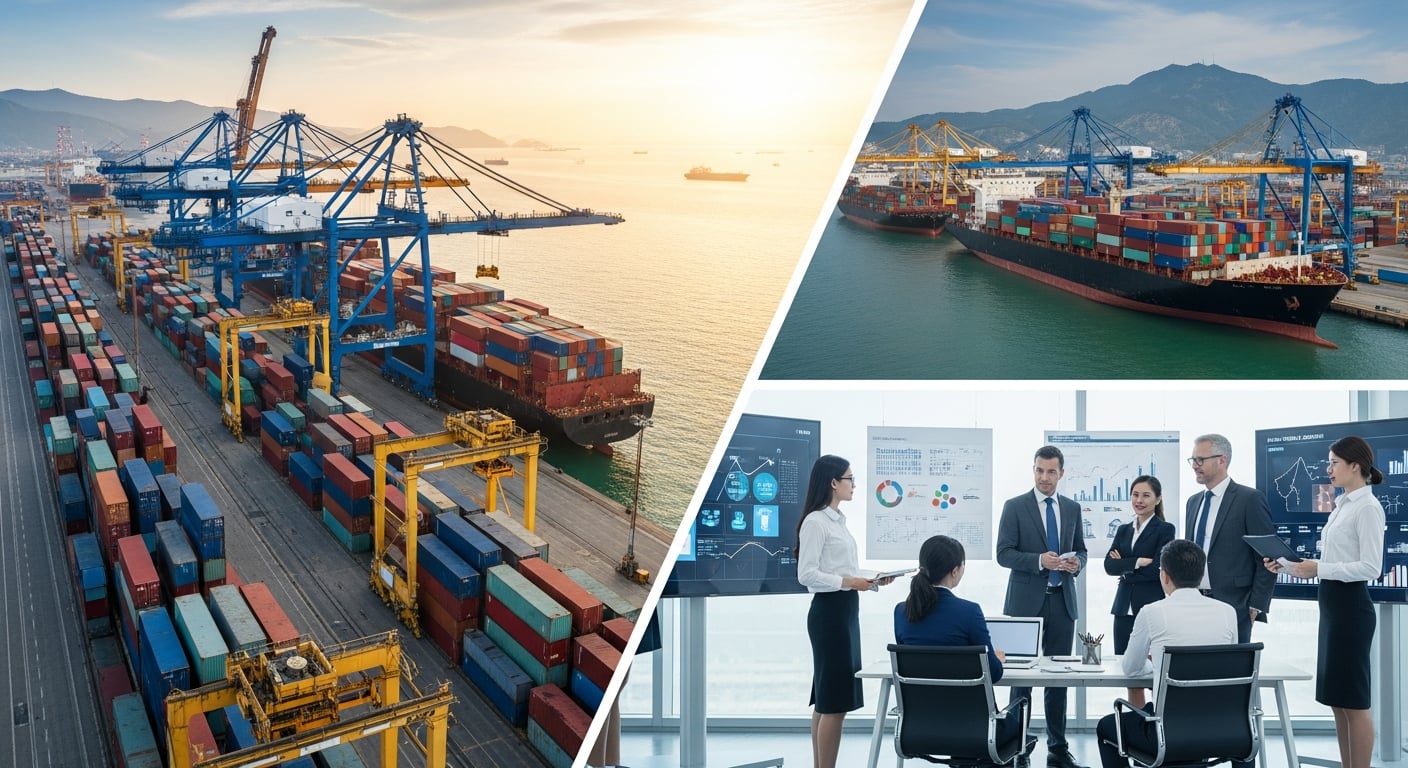
- Key Terminals: Cat Lai (the largest and busiest container terminal), Cai Mep-Thi Vai (a deep-water port capable of accommodating the largest ocean-going vessels, significantly reducing transit time from Europe and North America).
- Geographical Location: Serves as the gateway for the country's largest economic center, Ho Chi Minh City, and the adjacent southern provinces, including the Mekong Delta region.
- Specialization: Caters to the vast consumer market of Southern Vietnam, as well as industrial clusters located around Ho Chi Minh City and in Dong Nai, Binh Duong provinces.
- Features: High congestion at Cat Lai can lead to delays. Cai Mep-Thi Vai alleviates pressure on Cat Lai but requires additional planning for internal logistics to final consumers in Ho Chi Minh City and its surroundings.
Port of Hai Phong (Northern Vietnam)
- Key Terminals: Lach Huyen (a modern deep-water port, part of the Hai Phong International Gateway Port project), Dinh Vu.
- Geographical Location: Strategically located to serve the capital Hanoi and the rapidly developing industrial zones of Northern Vietnam (such as Bac Ninh, Hai Duong, Hung Yen), which are centers for electronics manufacturing, textiles, and machinery.
- Specialization: The primary hub for importing raw materials and components for northern industries, as well as goods for the consumer market of Hanoi.
- Features: Lach Huyen has significantly improved the region's logistical capabilities, allowing direct calls for larger vessels, which reduces transit time. However, internal logistics from Hai Phong to remote northern provinces require consideration of road infrastructure and potential congestion.
Port of Da Nang (Central Vietnam)
- Key Terminals: Tien Sa, Lien Chieu (planned for development).
- Geographical Location: Occupies a central position, acting as a link between the north and south. Serves the central provinces of Vietnam and the tourist region.
- Specialization: Smaller in volume than Ho Chi Minh and Hai Phong, but plays an important role in regional goods distribution.
- Features: Suitable for companies whose final sales point or production is located in the central provinces, helping to reduce internal logistics costs. Vessel call frequency may be lower than at major hubs.
Customs clearance and warehousing facilities are universal factors, but their efficiency can vary depending on the port. Fragmented courier infrastructure outside major cities requires careful planning for inland delivery, especially when dealing with central and rural regions. The choice of port determines a subsequent complex operational zone with a high cost of error.

THE ECONOMICS OF THE PROCESS.
The decision on port selection is deeply rooted in the economics of the process. Profit disappears not only in direct expenses but also in non-obvious costs that can be minimized or eliminated with proper strategic planning.
Direct Costs
- Freight: The cost of sea transport to the port of destination. While freight rates may be similar for major ports on the same routes, they can differ for less busy or remote ports.
- Port Fees and Handling: Includes costs for unloading, transshipment, and container storage at the port. These rates are standardized, but their total amount depends on the duration of cargo stay and the type of terminal.
- Customs Duties and Taxes: Import duties and Value Added Tax (VAT) are the main regulatory costs. They depend on the commodity nomenclature and do not change with the port; however, the speed and efficiency of customs clearance can affect timelines and indirect costs.
- Inland Transport: This is one of the most significant and often underestimated cost items. The cost of delivery from the port to the final destination (warehouse, distribution center, point of sale) can vary significantly. For example, land transport from Hai Phong to Ho Chi Minh may be more expensive and take longer than importing directly into Ho Chi Minh, and vice versa. This is where the direct risk of losing operational control and margin erosion becomes apparent if the final point of sale is significantly distant from the chosen port.
Indirect Costs and Risks
- Delays and Demurrage: High port congestion (especially Cat Lai in Ho Chi Minh) can lead to demurrage (penalty for container idle time at the port) and detention (penalty for late return of empty container), increasing the cost of goods. Delays also lead to lost profit due to untimely market entry of goods.
- Warehousing Costs: Long-term storage of cargo at the port or temporary storage warehouses before further shipment increases costs. Choosing a port close to the main warehouse or distribution center minimizes these expenses.
- Administrative and Regulatory Costs: Inefficient processes or the need for additional approvals at a specific port can lead to increased time and financial costs.
The economics of the process requires a comprehensive approach to calculating total landed cost, where all components are considered — from production cost to delivery to the final consumer. The problem here is not the availability of infrastructure, but its effective utilization, which directly impacts final profit.
AUDITING THE MODELS.
Effective management of import logistics through Vietnamese ports requires selecting an appropriate operational model. Each has its advantages and disadvantages in terms of control, investment, and risks.
Direct Import (Using Own Resources)
- Description: The company independently organizes all stages of the logistics process: from selecting the shipping line and port, to customs clearance and internal distribution. This assumes the presence of its own logistics department, local expertise, and licenses.
- Advantages: Full operational control, maximum flexibility in decision-making, potentially lower variable costs for large volumes due to the absence of intermediaries, direct interaction with regulators and service providers.
- Disadvantages: High capital and operational costs for establishing infrastructure and hiring personnel, the need for a deep understanding of local legislation and market specifics, assuming all risks associated with delays, errors, and changes in regulations. This model suits large importers with consistent and significant volumes.
Utilizing a 3PL Provider (Logistics Partner)
- Description: Delegating some or all logistics functions to an external specialized company (Third-Party Logistics provider). 3PL providers offer a wide range of services, from freight and customs clearance to warehousing and last-mile delivery.
- Advantages: Reduced operational burden and capital expenditures, access to partner's expertise and networks, increased flexibility (easier to scale operations up or down), reduced direct risks. Allows focus on core business activities.
- Disadvantages: Dependence on the competence and reliability of the partner, potential lack of pricing transparency, less control over process details, possible communication delays. Choosing a reliable 3PL provider is a critically important task requiring thorough verification of reputation and service capabilities.
Integrated Logistics Solutions (Major International Operators)
- Description: Utilizing comprehensive services of large international logistics operators who offer “door-to-door” services, combining sea transport, port handling, customs clearance, and internal distribution under a single management. This can be similar to an approach where logistics acts as a "marketplace" for services.
- Advantages: Simplification of the logistics chain, a single point of responsibility, minimization of coordination efforts, access to global networks and technologies.
- Disadvantages: Typically higher cost compared to self-organization or working with a local 3PL, less flexibility in customizing solutions, standardized approaches may not account for all specific business needs.
The choice of model depends on import volume, the level of control required, readiness to invest in local infrastructure and expertise, and appetite for risk. One can start with a partnership model to test the market, gradually transitioning to direct import as volumes grow and confidence in the operational environment increases.
THE DECISION ALGORITHM.
The decision-making process for selecting the optimal logistics hub for imports into Vietnam should follow a strict algorithm that minimizes risks and ensures maximum efficiency.
Step 1: Detailed Business Needs Analysis
- Geography of Final Sales: Determine the main regions where your goods will be distributed. Is it primarily Northern Vietnam, Southern Vietnam, or will distribution be uniform across the entire country? This is a key factor for reducing inland logistics costs.
- Import Volumes and Regularity: Estimate projected import volumes and frequency of shipments. High volumes may justify direct investment in infrastructure, while smaller volumes require flexible solutions.
- Cargo Specifics: Some goods (e.g., perishable, oversized, hazardous) require special handling and storage conditions that may not be available at all ports or terminals.
- Delivery Time Requirements: Define acceptable transit times from the port to the final consumer.
Step 2: Gathering and Evaluating Proposals
- Requests for Proposals (RFP) from Logistics Providers: Approach several vetted 3PL providers or major international operators with an RFP to calculate the total landed cost for each potential port (Hai Phong, Ho Chi Minh, Da Nang), considering your cargo specifics and final delivery points.
- Comparison of Financial Models: Analyze the proposals, paying attention not only to freight costs and port fees but also to inland transport expenses, possible additional charges, customs clearance times, and overall pricing transparency.
- Assessment of Operational Risks: Research the reputation and capabilities of providers in each region, their experience with specific ports and types of cargo.
Step 3: Pilot Shipment
- Selecting the Most Optimal Scenario: Based on detailed analysis, choose one or two most promising ports and logistics partners.
- Executing a Test Shipment: Organize a pilot consignment of goods through the chosen port. This will allow verification of calculations in practice, identification of operational nuances, and assessment of the speed and quality of customs and inland logistics. Do not start with inflated expectations regarding the process's perfection.
- Collecting Feedback: Accumulate data on all stages of the pilot shipment: actual timelines, costs, communication quality, promptness in resolving emerging issues.
Step 4: Analyzing Results and Adjustment
- Detailed Pilot Review: Compare actual performance indicators with planned ones. Identify discrepancies, their causes, and potential optimization paths.
- Strategy Adjustment: Based on the data obtained, make changes to the logistics strategy. It may be necessary to reconsider the choice of port, change partners, optimize inland delivery routes, or review contract terms.
Step 5: Scaling and Continuous Monitoring
- Scaling Operations: Upon successful completion of the pilot and strategy adjustment, you can proceed with increasing import volumes.
- Continuous Monitoring: The logistics environment is dynamic. Regularly track changes in port infrastructure, customs regulations, tariffs, and the performance of selected partners. This will ensure the long-term effectiveness of your import activities in Vietnam.