When the EU–Vietnam Global Gateway forum announced new European investments in transport and logistics in March 2026, I caught myself thinking: my clients from Russia are reading this news as macroeconomics. But it's not macroeconomics. It's a new configuration of the supply chain—one you either integrate into or pay for twice.
Let me break down what actually happened and why it matters to anyone sourcing in Asia or launching products on Asian marketplaces.
The fact we'll start with
In 2026, the European Union confirmed Vietnam as its main trade anchor in ASEAN. According to the European Commission, total EU–Vietnam trade turnover in 2025 reached €76 billion. Vietnam is the EU's fourteenth-largest goods partner globally and first in ASEAN.
Vietnam's Ministry of Industry and Trade (MOIT) gives its own figure—over $73.8 billion in bilateral trade for 2025, up nearly 8% year on year. The discrepancy with the European estimate is a matter of currency and methodology, not substance. The substance is in the direction of movement.
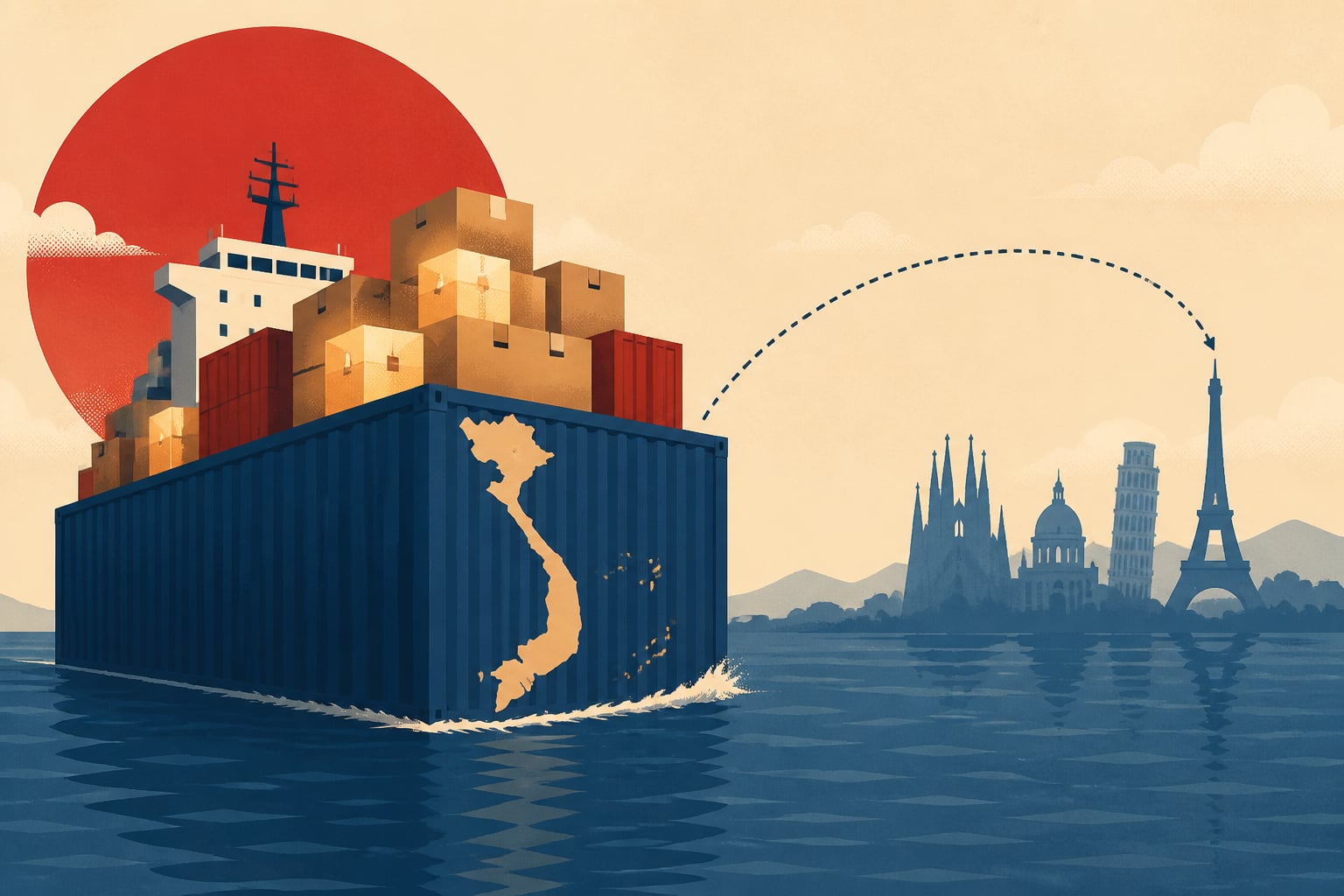
And this isn't trade for trade's sake. At the Global Gateway forum in March 2026, the European Union announced a package of investments in Vietnam's transport, logistics, and digital infrastructure—individual commitments are valued at €560 million, according to EEAS materials.
Read that literally: Europeans are investing not in factories, but in what services those factories. Ports, warehouses, digital corridors.
What the data shows
Three numbers I keep in mind when discussing logistics through Vietnam with brands.
- Accumulated Dutch investment in Vietnam—around $15 billion, making the Netherlands the largest EU investor, according to the Dutch Business Association Vietnam.
- Total registered foreign capital in Vietnam as of December 31, 2025—$38.42 billion, per a VAFIE report.
- The EuroCham Business Confidence Index (BCI) for European business rose to 79.7 points in Q2 2026 from 72.7 in Q1, according to EuroCham. That's near a seven-year high.
A separate story is regulatory. As of January 1, 2026, CBAM—the European carbon levy—entered its payment phase. According to MOIT clarifications, roughly 5.4% of Vietnam's exports to the EU fall under CBAM, with concentration within that group in metals—about 90%.
It seems like this is about steel and aluminum, not e-commerce. In reality, it's not.
Why this matters more than it seems
European business in Vietnam is doing three things at once.
First—it's taking the best production capacity. The same factory that was sewing for a regional brand yesterday is today getting a contract from a European retail chain with a three-year volume guarantee. Your order of 5,000 units goes to the back of the queue.
Second—it's raising the bar on quality and documentation. European clients demand traceability, certification, carbon footprint reporting. The supplier learns to do it. A year later, they're no longer willing to work with a buyer who asks for "just cheaper."
Third—it's building logistics for itself. Warehouses, consolidation hubs, direct shipping lines. Infrastructure paid for by European capital becomes more accessible to everyone. But priority access goes to those who built it.
This isn't about Vietnam closing its doors to Russian buyers. It's about the cost of entry rising and the door narrowing.

And here's where the shift I see in negotiations begins. Brands come in thinking "we need to find a cheaper supplier." I don't argue: price matters. But in 2026 in Vietnam, a cheap supplier without certifications is a supplier who will be snapped up by a European contract within six months. And you'll be left searching again.
What I see from operations
At VietSmart, we guide partners through Ho Chi Minh City and Hai Phong, and over the past year the picture has changed noticeably.
Factories we worked with two years ago as "flexible and small" now ask for quarterly volume confirmation in advance and prepayment. The reason is simple: they've acquired an anchor European client, and our batches have become a supplement rather than a base for them.
Second observation—on documentation. Requests for conformity certificates, lab reports, and raw material origin data from Vietnamese suppliers have grown exponentially. Previously, we had to pull this out of them. Now some factories send the package themselves—because their European client taught them to.
Third—logistics. Consolidation rates at ports in southern Vietnam are more stable than a year ago, and timelines are more predictable. EU infrastructure money is working, even if you have nothing to do with it.
And now the unpleasant part. A Russian brand that enters Vietnam with the position "we're small, give us special terms" increasingly hears a polite "no." Not because of politics. Because of the queue.
What a brand should do
Don't look for a "Vietnamese supplier." Look for a place in the chain that Europeans are building.
- Ask your current and potential suppliers for a list of valid certificates and verify the numbers in Vietnam's registries. If a supplier can't provide a number, they're not in the European chain.
- Ask directly whether the factory has an anchor EU client and what share they represent. An answer of "yes, about half" means a risk of delays—plan a buffer.
- Check whether your category falls under CBAM or European labeling requirements. If so, calculate the carbon footprint in advance, not at the moment of shipment.
- Split suppliers into two pools: those working for the EU (quality and documentation) and those working for the region (flexibility and price). Don't try to get both from one factory.
- Include a clause in the contract about priority for your batch during capacity overload. This is standard practice in European contracts, and Vietnamese factories understand it.
In short: Vietnam is becoming not a "cheap factory of Asia" but a production hub with European standards. This raises the bar for everyone sourcing here.
At VietSmart, we maintain an operational picture of suppliers, ports, and timelines in Ho Chi Minh City and Hai Phong and update it weekly. The team builds a supplier map for a brand with verified certifications and realistic timelines—usually taking 3–4 weeks to the first qualified sample. If you're planning a purchase or entering Asian marketplaces this year, start with this map, not with the search for the lowest price. The lowest price in 2026 is almost always the shortest contract.