
What Happened
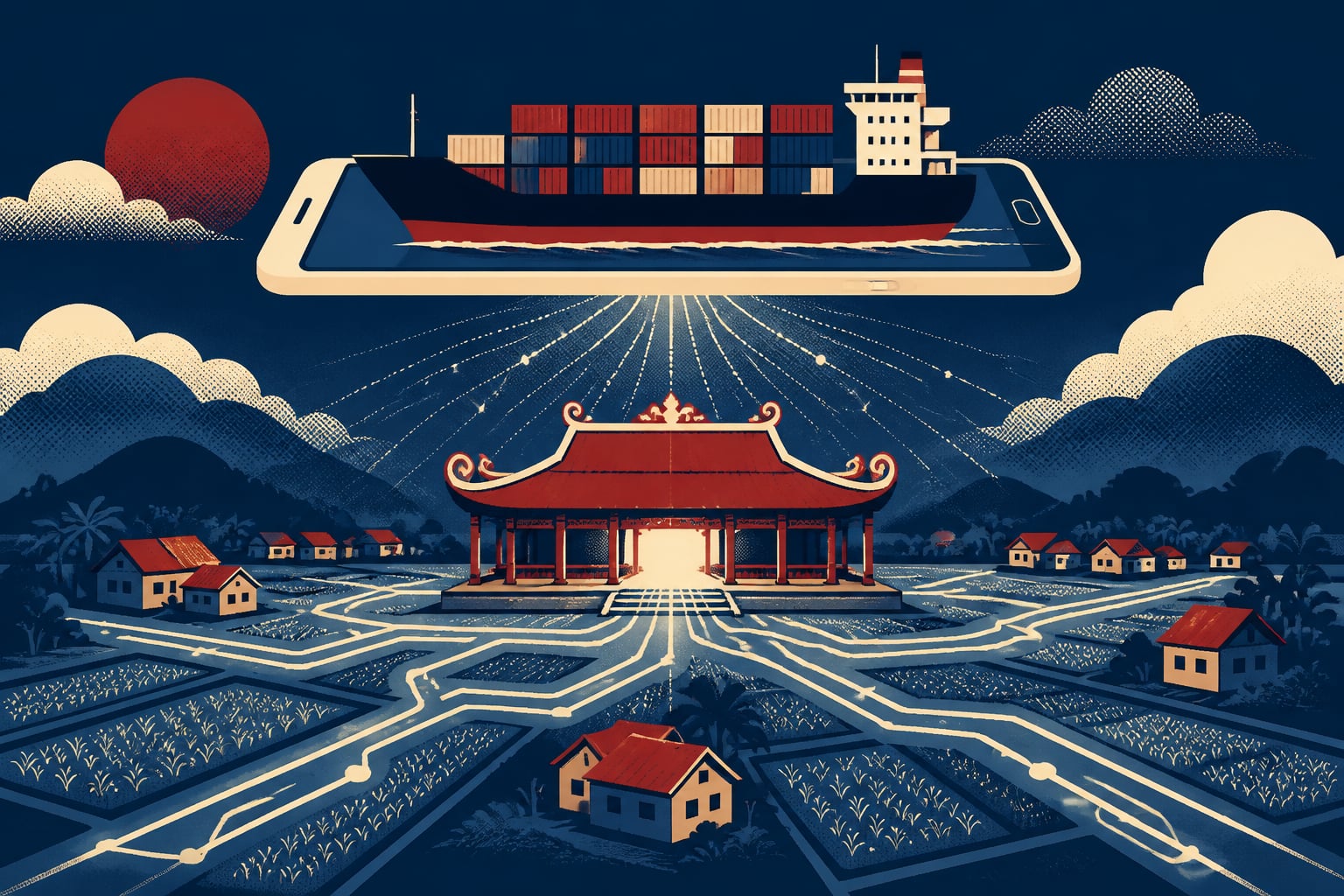
In early October 2026, Vietnam's program supporting the "E-commerce Commune/Ward" model reached a new stage: 15 provinces and cities in the northern part of the country joined it. This was reported by Vietnam.vn on October 10, 2026.
The term "e-commerce commune" itself describes a grassroots unit of digitalization: a commune or urban ward administration receives methodological, technical, and regulatory support so that local producers, cooperatives, and family businesses can enter marketplaces. This is not about the flagship hubs of Hanoi and Ho Chi Minh City, but about what lies 100–300 km from them: farming cooperatives, craft workshops, and agricultural processing.
Importantly, the model relies on a legal framework. According to MOIT (Vietnam's Ministry of Industry and Trade), the Department of Industry and Trade of Vinh Long Province, together with the eComDX center at iDEA, held training sessions on July 7–9, 2026, on implementing the 2025 E-Commerce Law: disclosure of platform ranking criteria, electronic verification of sellers, and monitoring of violations. In parallel, the 2025 Digital Transformation Law is in effect — according to Baonghean, provinces are running campaigns in 2026 to update registries and create local platforms based on it.
The logistics contour is being built separately for this. According to Bao Nghe An, on July 6, 2026, the People's Committee of Nghe An Province and Vietnam Post (VNPost) signed a cooperation agreement for 2026–2030: postal infrastructure, digital transformation, e-commerce support, cashless payments, and electronic signatures.
What It Means
For a Russian seller, this is primarily a question of entry cost and supply chain structure. Vietnam is ceasing to be a "factory by the sea" and is turning into a country with a distributed network of small and medium-sized producers that have a digital sales channel and a trained administrative apparatus on the ground. In practice, this means that within 12–24 months, a Russian brand will have the opportunity to work not only with large exporters from Ho Chi Minh City but also with province-level cooperatives — with direct access to primary production.
The second effect is supply chain transparency. The 2025 E-Commerce Law introduces electronic verification of sellers and monitoring of violations. For a Russian importer, this is a chance to get a supplier that already has a digital footprint: transaction history, platform registration, and confirmed legal status. This radically reduces the risk of a "gray" intermediary, which today often stands between a Russian brand and a Vietnamese workshop.
The third effect is logistics. Provinces' agreements with VNPost for 2026–2030 mean that cargo consolidation and delivery from remote areas will be standardized. Today, to ship a batch from a remote province, a Russian buyer often has to build their own scheme: hire a local carrier, negotiate consolidation, and sort out documents. If VNPost covers this layer, costs and timelines become predictable.
The fourth, less obvious effect is competition for attention. Vietnamese provinces are now actively promoting OCOP (One Commune One Product) goods through livestreams and regional portals. According to Vietnam News, An Giang Province has already introduced more than 300 OCOP products and plans to expand e-commerce in border and mountainous areas for 2027–2030. This means that some Vietnamese producers will be learning to sell directly to Western and Asian marketplaces — and a Russian brand is not first in that queue. Early entry provides an advantage.
I should note separately: no single official document that directly establishes a network of exactly 15 provinces was found in MOIT's public releases. According to Bao Dien Bien Phu, provinces are publishing their own initiatives: in Dien Bien, 138 OCOP products have been uploaded to the regional portal, and more than 1,200 farmers have received support to open online accounts. So this is a wave of local projects, not a single centralized program. For a practitioner, this is more of a plus: you can choose a specific province and work with it directly.
Expert Commentary from VietSmart
I regularly see the same mistake by Russian entrepreneurs in operations in Ho Chi Minh City: they arrive with the request "give us a factory that will make our product under our brand," and they go to large intermediaries because those speak English and send a price list within a day. Six months later, it turns out that the margin has been eaten up by three layers of markups, and the actual producer is in a province no one in Moscow has heard of.
The "e-commerce commune" model breaks this scheme. The Vietnamese state is effectively building infrastructure that allows direct access to the primary producer — with a trained administrator on the ground, a digital registry, and a postal operator that picks up the cargo. Our recommendation: don't wait for this model to become mainstream and for prices to level out. Enter now, when provincial departments of industry and trade are themselves looking for external buyers and are ready to support the deal.

Conclusions and What to Do
- Request a list of verified suppliers. Contact the department of industry and trade of a specific northern province (Vinh Long, Nghe An, Dien Bien — according to MOIT, Baonghean, and Bao Dien Bien Phu, training on the 2025 E-Commerce Law is already underway there) and ask for a list of producers with electronic verification.
- Check the supplier's status in the digital registry. Since 2025, electronic verification of sellers has been required. Ask the supplier for confirmation of platform registration and legal status — this filters out fly-by-night intermediaries.
- Test logistics through VNPost. Under provinces' agreements with Vietnam Post for 2026–2030, the postal operator takes on consolidation and delivery from remote areas. Ask VNPost for a quote on the route "province — Hai Phong or Cat Lai port" and compare it with your current scheme through Ho Chi Minh City freight forwarders.
- Reserve a place in the OCOP category. Vietnamese provinces promote OCOP goods through livestreams and regional portals (An Giang — more than 300 items according to Vietnam News). If your product falls into this category, early contact with the provincial operator gives you priority in the selection.
- Include 2–3 provinces in your diversification strategy. Don't build supplies around a single hub. The northern group of provinces is now receiving state support — this is a window of opportunity for 12–24 months, while competition for primary producers is low.
Source: Vietnam.vn dated October 10, 2026