
WHAT HAPPENED
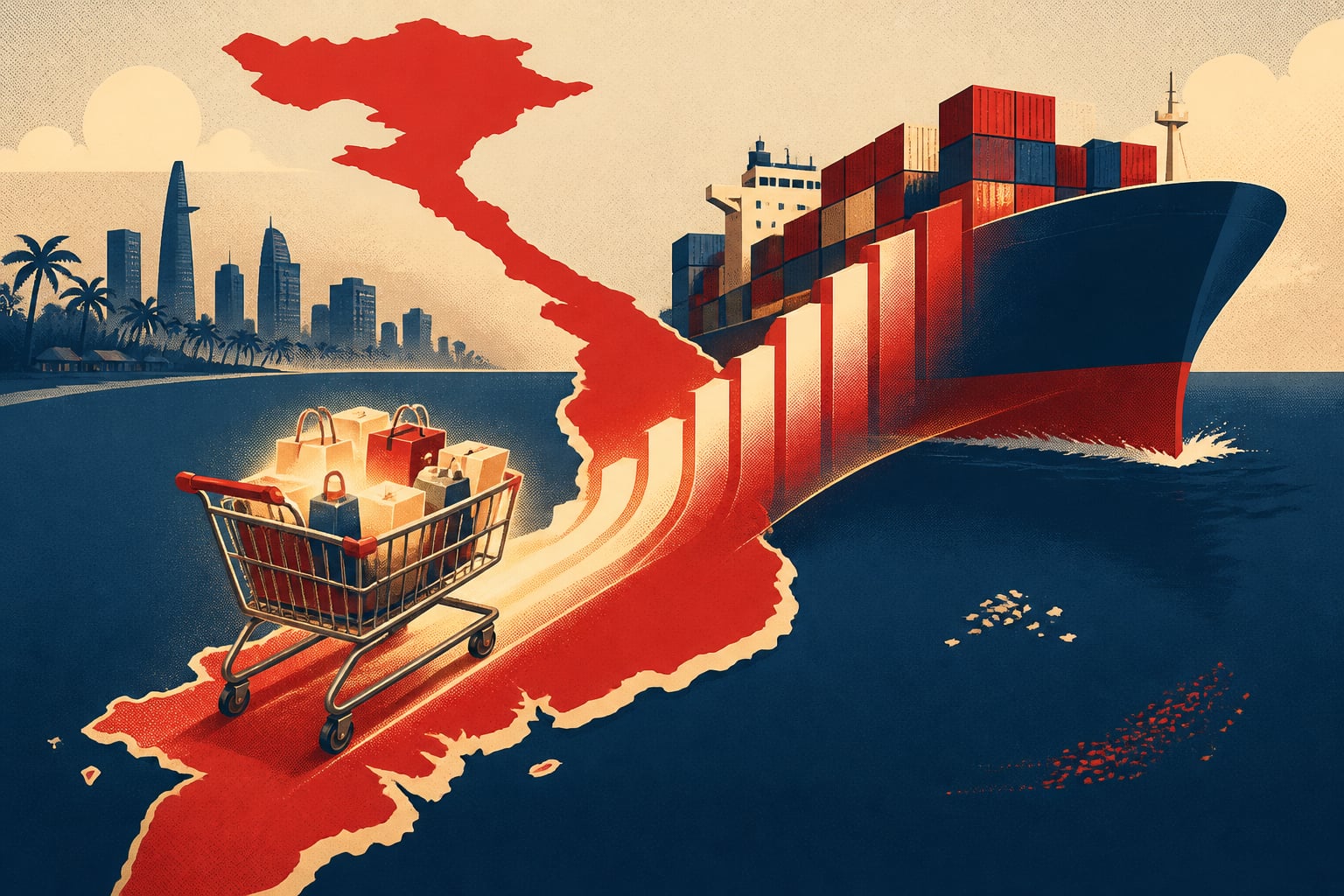
On October 6, 2026, analytics firm Cube, together with marketplace Lazada, released "The 2026 eCommerce Savvy Shopper Report: Southeast Asia." The study covered 6,000 online shoppers aged 18 to 61 across six Southeast Asian markets: Vietnam, Indonesia, Malaysia, the Philippines, Singapore, and Thailand. Respondents were assessed across four dimensions: seller verification, value optimization, digital literacy, and confidence in consumer rights protection, according to VnEconomy.
The key figure for Vietnam: one in four online shoppers (25%) falls into the savvy shopper category, and this segment spends on average 44% more per month than the typical buyer. The Southeast Asia average is 31%, meaning Vietnam significantly outpaces the region. The report estimates the total annual spending gap between "smart" and other Vietnamese shoppers at approximately $2.2 billion — the second-highest in Southeast Asia after the Philippines.
Behavior is confirmed by operational data. During the 9.9 Brand Super Sale on Lazada, orders over $100 (about 2.6 million dong) accounted for 42% of total sales volume, with three out of four such orders going through LazMall — official brand stores. Do Cao Quoc Huy, Director of Retail and Categories at Lazada Vietnam, describes this as the country's e-commerce entering a "more mature phase."
WHAT THIS MEANS
For a Russian entrepreneur looking at Vietnam as an entry market, this news matters not in itself but as an indicator of demand structure. Previously, Vietnam in the eyes of outside observers was a price market: the cheaper player won. Now a layer of shoppers is emerging who are willing to pay more — but not for the brand as such, but for the uncertainty removed. They verify the seller, compare, read reviews, and wait for an official guarantee. That is precisely why 42% of sales during the promotion came from expensive orders, not the mass cheap segment.
At the same time, the report does not negate general caution. Vietnam's National Statistics Office estimates retail sales of goods for the first eight months of 2026 at 3,947.6 trillion dong (about $150.7 billion), up 12.8% year-on-year, but Tuoi Tre notes that consumers are maintaining a restrained spending pattern. Havas Vietnam, in its study on the "new value equation," speaks directly of heightened price sensitivity. The picture is not contradictory but segmented: one part of the market saves, another consciously pays more. Betting on an "average check for everyone" is a losing strategy.
The third layer is digital literacy. According to Visa and Vietnam Report surveys for 2026, 44.4% of Vietnamese shoppers use AI to gather product information, 23.5% for search and recommendations, and 19.8% for comparing brands. This means the purchase decision is increasingly made before visiting the product page. If your content, reviews, and seller data cannot withstand algorithmic scrutiny and side-by-side comparison, you drop out of the funnel before the buyer even sees the price.
For Russian brands, this overturns the usual entry logic. Dumping on entry into Southeast Asia no longer buys loyalty — it buys a one-time order and a negative review, because the "smart" shopper is precisely looking for confirmation that cheap is not for them. It is far more profitable to enter with a narrow premium niche, transparent product origin, an official Lazada store, and a clear guarantee.
VIETSMART EXPERT COMMENTARY
I see this mistake in operations in Ho Chi Minh City almost every week. A Russian brand arrives with a good product, opens a regular store on the marketplace, prices it 15% below the competitor, and waits for volume. A month later — 200 orders, an average check of 180,000 dong, and zero repeat purchases. Meanwhile, a brand that entered through LazMall, spent two weeks on verification, uploaded certificates, and refused to play the price game, collects orders at 2.6 million dong and lives on repeats. The difference is not in the product, but in the fact that the second seller sold not a product but confidence.
If I were a Russian entrepreneur, I would not try to compete for the 75% of the market that counts every penny. I would build an offering for the 25% who are already willing to pay 44% more, and do it through an official brand channel, a local guarantee, and an honest product page that is not embarrassing to show an AI assistant.

CONCLUSIONS AND WHAT TO DO
- Check your niche for premium capacity. Take categories where the Vietnamese shopper is already voting with money: orders over $100 accounted for 42% of revenue during the 9.9 sale. If your product doesn't work in this logic, don't waste budget on entry.
- Enter through LazMall, not the general marketplace. Three out of four expensive orders on 9.9 went through official brand stores. Seller verification is the first dimension by which the report assesses the "smart" shopper.
- Prepare your document package before starting sales. Certificates of conformity, documents of origin, warranty terms in Vietnamese. Without this, you won't pass the filter of either the buyer or the AI assistant that gathers product information on their behalf.
- Rewrite your product page for comparison. 19.8% of shoppers use AI specifically to compare brands. Specifications must be machine-readable, reviews must be specific, not just "everything's great."
- Don't play the price game on entry. Given the general spending caution noted by Tuoi Tre, lowering the price attracts the wrong segment and kills margin. Better to spend the same money on a local guarantee and service.
Source: Vietnam.vn dated October 7, 2026