WHAT HAPPENED
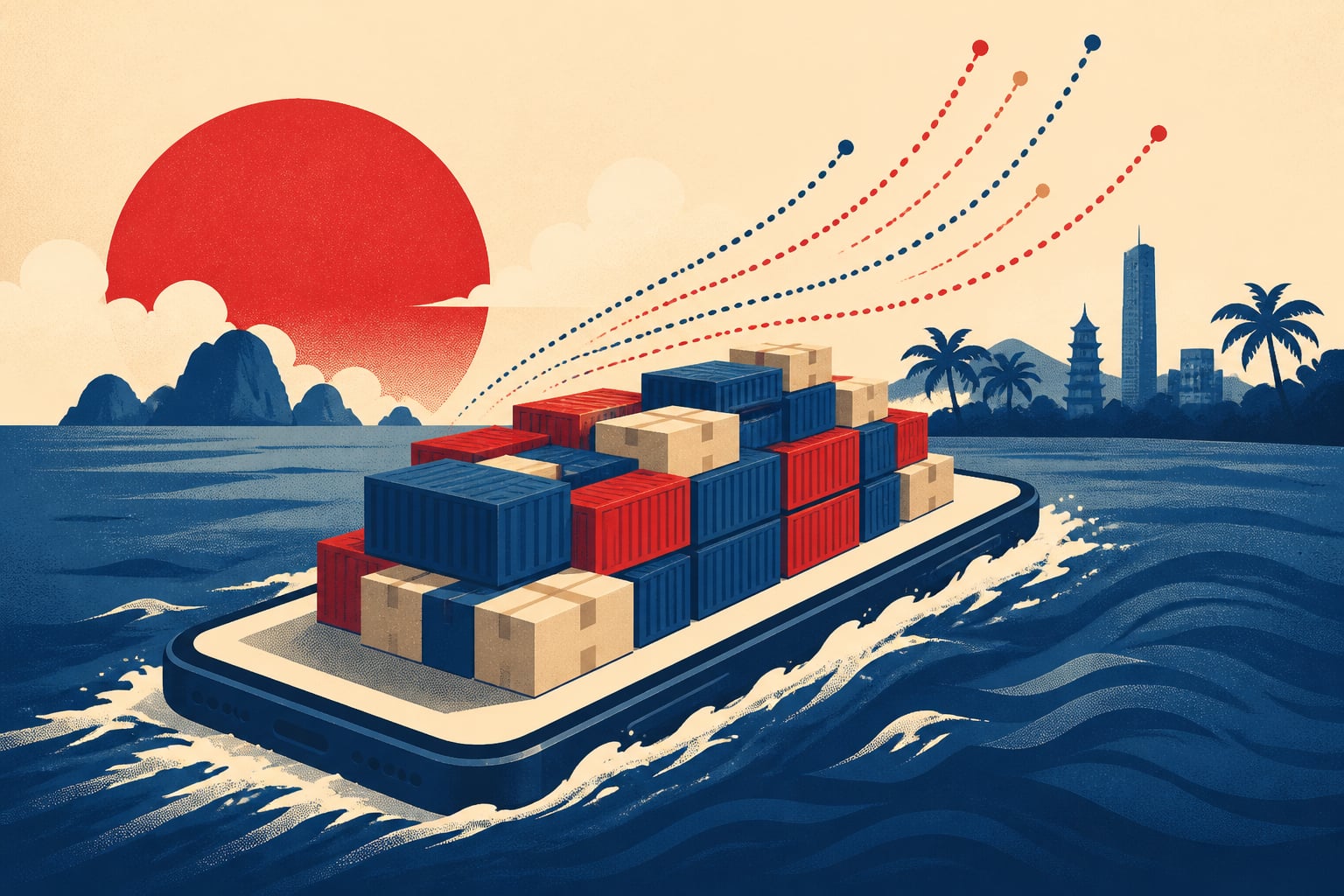
On September 22, 2026, Vietnam.vn published a piece on how Vietnamese brands are driving e-commerce growth through two parallel strategies: expanding customer touchpoints and optimizing delivery. This is not a local news item about a marketing tactic, but a cross-section of a model that has taken shape in Vietnam over the past two years.
The context in which this model operates is set by regulation. The Law on E-Commerce 122/2025/QH15 was passed by the 15th National Assembly on December 10, 2025, and takes effect on July 1, 2026 — as reported by the Ministry of Industry and Trade of Vietnam (MOIT). In parallel, the Master Plan for National E-Commerce Development for 2026–2030 is in force, approved by Decision 1568/QD-BCT (2025). In other words, platforms and brands are not operating in a vacuum but within a pre-designed framework.
The numbers confirm the scale. According to the “Overview Report on Vietnam's Domestic Market 2025”, Vietnam's online retail volume in 2025 is estimated at approximately USD 32 billion — about 12% of total retail sales of goods and services. The same report notes that postal and courier services handled around 2.4 billion parcels in 2024, roughly 30% more than the previous year.
WHAT IT MEANS
The first thing that stands out when analyzing the Vietnamese model: brands have stopped fighting for traffic in a single channel. They build presence where the buyer physically is — in the app, in the messenger, in the offline store, at the pickup point. This is the expansion of touchpoints that Vietnam.vn writes about. For a Russian marketplace seller, this means a simple thing: betting only on a product listing within a single marketplace becomes vulnerable. A buyer who knows the brand, not just a link to a product, brings less dependence on the platform's algorithms.
The second layer is logistics. B&Company data in Whitebook 2025 shows that Vietnam has developed a shortage of distribution capacity, and the market is responding with rapid growth of dark stores and spoke warehouses. Shopee, according to the same report, invested in two distribution hubs of over 100,000 m² each — in Hanoi and Binh Duong — and works with local express operators GHTK, GHN, and Ninja Van. This is no longer about “delivery in general,” but about a managed last-mile economy.
The third layer is retention. Vietnamese conglomerates are building super apps: Vingroup in 2026 launched V-App, uniting the group's services — as reported by VnExpress. Masan is developing WinCommerce and Winmart, Mobile World — Bach Hoa Xanh. The logic is the same: retain the buyer within one's ecosystem and avoid paying the marketplace for every repeat order. Russian e-commerce is moving in the same direction, just a few years behind.
Separately, keep the regulatory track in mind. Vietnam regulates not only platforms but also mobile commerce: the integrated document 08/VBHN-BCT (2026) describes the management of commerce via applications, taking into account amendments introduced by Circular 38/2025/TT-BCT of June 19, 2025. This is a signal: the more tightly a brand integrates sales into an app, the more important it is to understand the administration rules of that channel in advance.
VIETSMART EXPERT COMMENTARY
I regularly see the same picture in operations in Ho Chi Minh City: Russian entrepreneurs come with the request “get us onto a Vietnamese marketplace,” and a month later it turns out they have no own pickup point, no working retention channel, and no understanding of who exactly will carry the goods from the hub to the door. The most common mistake is to think that expanding touchpoints and optimizing delivery are two separate tasks. In Vietnam, they are one budget and one plan. If you optimize delivery but don't give the buyer a reason to return directly, you are simply subsidizing someone else's funnel.

What we would do in the place of a Russian entrepreneur: first calculate the real cost of a repeat order through the marketplace — including commission, promotion, and discounts — and compare it with the cost of an own channel. Usually the gap turns out to be large enough to justify investment in a pickup point or in own logistics at the local level.
CONCLUSIONS AND WHAT TO DO
- Calculate the cost of repeat contact. Take the last three repeat orders and subtract from the margin the platform commission, promotion costs, and discount mechanics. The resulting figure is your budget for an alternative channel. Without this calculation, any decision about own logistics will be guesswork.
- Check your logistics provider for real last-mile capability. Not by presentation, but by fact: ask the operator for a list of hubs and pickup points in your region, delivery times to specific districts, and return SLAs. In Vietnam, Shopee works with GHTK, GHN, and Ninja Van precisely because they have physical density, not because they have a beautiful website.
- Set up at least one direct retention channel. This could be your own pickup point, a Telegram channel with repeat sales, or an app. The goal is not to leave the marketplace, but to avoid paying commission for every loyal customer.
- Study the regulatory track in advance. If you plan to sell through an app, look at the logic of documents like Vietnam's 08/VBHN-BCT (2026) and Russian marketplace requirements. Rules change faster than investments in a channel pay off.
- Look at Vietnam as a leading indicator. What has already become the norm here — dark stores, super apps, marketplace partnerships with express operators — will come to Russia. Those who start adapting their strategy before it becomes a survival requirement will win.
Source: Vietnam.vn dated September 22, 2026